

THIS POST MAY CONTAIN AFFILIATE LINKS. PLEASE SEE MY DISCLOSURES. FOR MORE INFORMATION.
 It’s no secret that I am all for passive investing, also know as buy and hold, compared to active investing (you can learn about the differences between the two in this post). After looking at the data that 80% of active managers fail to beat the market in a given year, you are foolish to pay the higher expenses of actively managed mutual funds.You are better off buying a low cost index fund and holding it through the good times and the bad.
In this post, I will walk you through why buy and hold investing is the path to wealth, even in this volatile investing environment.
How Buy And Hold Works
I recently came across the below chart and it blew me away. It breaks out the annualized returns of various investment categories over 20 a year period. It is interesting to see that after the huge run up in housing prices, the collapse has resulted in the annualized return of house prices to be just under 3%, which is roughly the historical average.
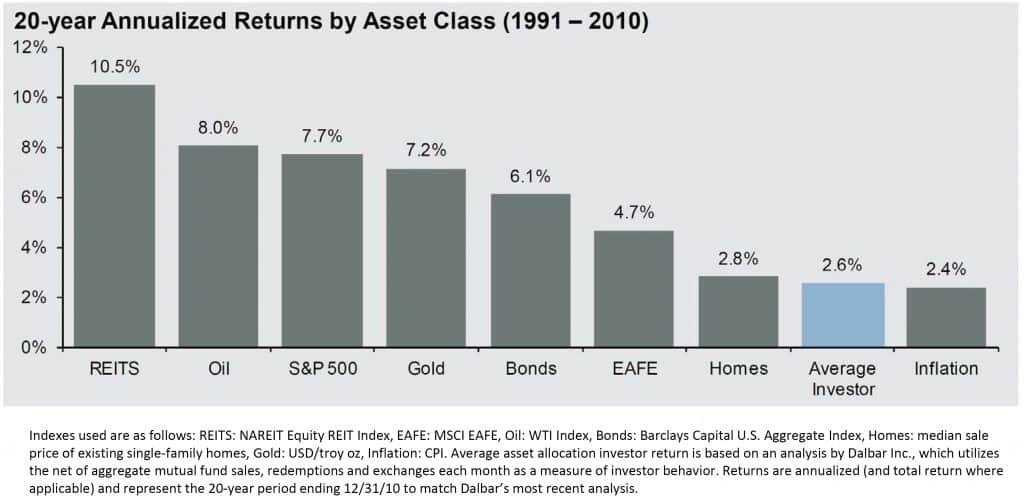
But the most interesting part is this: Look at the column for the S&P 500. Over 20 years, it has returned just under 8% per year. That means if you took your money and put it in an S&P 500 index fund and left it alone (buy and hold), your return would have been just shy of 8% per year over these 20 years.
Now, scroll over to the right and notice the column marked as the average investor. The Average Joe returned a measly 2.6% per year over the same 20 years. How did they come up with this number?
The study looked at mutual fund inflows and outflows of money. Another way to say this is the amount of money investors invested in the market and withdrew from the market. This doesn’t just mean money that you invested, then took out of the market to hide under you mattress. It also includes the times when you invest money into one fund, dislike your return, sell and buy another fund. That too is an inflow of money (purchasing the fund), an outflow of money (selling the fund), and then another inflow (buying the new fund).
Why such a drastic difference? The answer is because the lack of discipline and not understanding the importance of buy and hold. When the market drops, investors get scared and take their money out of the market. The market rebounds, but the average investor is still on the sidelines, scared.
By the time he or she gets the courage to invest again, the majority of the run-up has occurred. Any gain is wiped out as they ride the market back down and sell at the bottom, scared that the market will continue to drop. This cycle repeats itself over and over again. See the picture below for a visual representation of this cycle.

The Difference In Return With Buy And Hold
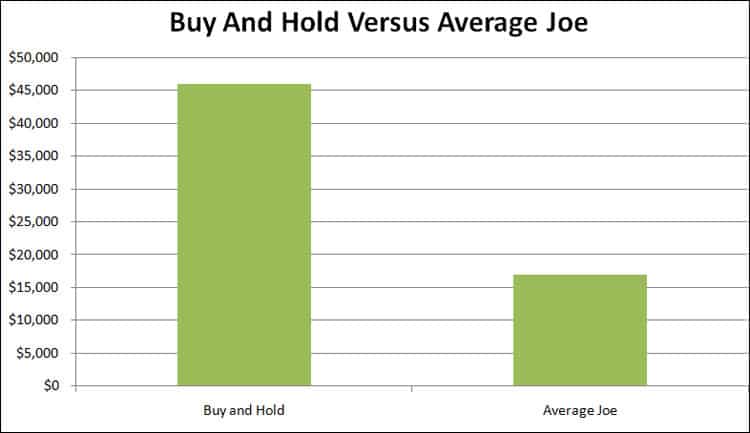
What does this difference in return between investing in the S&P 500 over the 20 years (buy and hold) and investing as the Average Joe look like in dollar terms? Let’s say you invested $10,000. After 20 years, had you invested in the S&P 500 and stayed invested through all of the ups and downs, returning 8% annually, you would have over $46,000. If you bought and sold like the average investor does, you would have $17,000. That’s a $30,000 difference!
Tips To Succeed With Buy And Hold
How do you avoid being another average investor? Buy and hold. Don’t sell when the market is tanking. It’s a simple idea, but it’s not easy because of your emotions. But if you can get a handle on your emotions, you will see gains when investing in the stock market.
Here are some more tips to help you stay invested over the long term:
- Have a plan. It is proven that the most successful investors are ones with a plan. When you have a plan with your goals and objectives, you can refer back to it when the market is swinging wildly. You plan will help to remind you why you are investing as you are and stop you from making rash decisions.
- Tune out the media. They promote fear and exuberance. If the market is dropping, don’t watch the news or read the paper. If you do, laugh when you see the picture of the person on Wall Street with anguish on his face. I swear they have that picture saved for these moments. They always show it.
- Don’t look at your investments every single day. Seeing big swings or losses in your account will only magnify the issue, worrying you even more and eventually causing you to abandon your buy and hold strategy. Decide to look at your investments on a quarterly basis. If you need to look more often, then only do so after a really good day on Wall Street. Even if you have losses, you can focus on the fact that you made $X today.
- Keep things in perspective. When the market drops, you have to realize that the market is going to come back. It always does. Look at the drops as buying opportunities. Some even suggest you look at a market drop the same as a sale at the grocery store. When the store drops prices, you don’t get scared and stop buying the item. You buy more because you are getting a deal. In many ways, the stock market is the same. My biggest returns have been on investments that I bought after huge market drops.
- Learn about investing. A great way to get in control of you emotions and fear of investing is to educate yourself. The more you understand about investing, the less your emotions will dictate your decisions. You don’t need to get a PhD, but rather just the basics which will benefit you greatly. I’ve written an eBook, 7 Investing Steps That Will Make You Wealthy that does just this. As you can tell from the title, it is all about investing and what you need to do in order to be successful at investing.
Where To Invest With A Buy And Hold Strategy
When you are ready to implement a buy and hold investing strategy, where should you open an account and invest? There are lots of online brokers out there, but not all are great for a buy and hold investor because of the fees many charge.
I have highlighted my choices for you below. For other options, you can check out my online broker comparison chart.
- Betterment: Betterment is a robo-advisor that is a perfect place for a buy and hold investor. You take 10 minutes to set up an account and an automatic monthly deposit and you are done. They take care of everything (and I mean everything) from that point forward. You can open an account here.
- Motif Investing: Motif Investing allows you to create a “motif” of stocks and invest in all for roughly the same price most other brokers charge to invest in a single stock. You can choose a pre-made motif of stocks or create your own. You can even sign up for their free Horizon portfolios as well. Here is a link to get started.
- Charles Schwab: Schwab is the gold standard when it comes to an online broker. You can invest in a huge variety of low cost mutual funds and ETFs (some ETFs are free to trade), including Schwab’s own funds. The great part about investing in a Schwab mutual fund is that you can get started with just $100 and invest as little as $1 going forward! You can open an account here.
- Vanguard: Vanguard is the one that started the buy and hold trend. They offer nothing but low cost investments to investors. While you will need at least $3,000 to get started with them, if you have the money, they are definitely worth a consideration. Here is a link to get started.
Finally, if you want to stick with your current broker, do yourself a favor and sign up for a free account with Personal Capital. Doing so will show you not only how much money you are paying in fees, but also how diversified you are. Both of these are critical to being successful over the long term. You can learn all about their service here.
Final Thoughts
Do what you have to do in order to stay in the market over the long term. It makes a difference when you constantly buy and sell all of the time. You may read everywhere about buying and selling and being an active investor. Remember that firms are encouraging you to trade because that is how they make money – through trading fees and commissions.
You don’t have to trade to be a successful investor. In fact, as I’ve shown in this post, you will most likely be more successful by not trading and instead use a strategy of buy and hold investing.

I'm a big passive investing guy, too. My favorite strategy is actually "buy and buy more" 🙂
Buy and buy more….I like it!!
@Nick: If we do the same calculations between 2000 and 2010, the results would be very different. The results of the S & P-500 would be negative, the REITS would be very low, the highest gold etc. etc. Wait 10 years for the S & P-500 has a negative result is very frustrating. Between 1991 and 2000, Wall Street had a comportmiento hardly repeat that. Today, buy and hold, is too risky. You can lose a lot of your money.
Or become a contrarian. When everyone is screaming buy buy you should be getting into cash and when they all proclaim the end of free markets pile back in with all ya got. There's got to be a study out there that looks at contrarian investing?
Fear and greed.
Two biggest mistakes investors make is pulling the money out when the market is going down, and the other is when they stop contributing until they "see things turn around."
Timing the market just doesn't work for the average Joe and by not continuing to contribute you eliminate the helpfulness of dollar cost averaging.
Well said. Sadly many investors missed out the recent run-up of the market because they are too scared to invest. You just have to invest and keep investing and tune out the short-term news stories.
Nice post Jon! I know many will derail buy and hold as ancient or something that does not work when, in actuality, it can work very well if you do it right. If you buy and forget then it may not work, but if you’re smart about it and not listen to the noise out there it can work quite well.
I agree with the buy and buy more. With the amount of volatility that is in the market it’s tough to just sit and forget while still making profits that are worth it.
I’m strongly in the buy and hold camp. I believe in choosing my investments based on their valuations and underlying fundamentals and then holding them until they reach one of my exit criteria – which are all based on the emergence of substantive structural problems in the company rather than just gains or losses.
That’s a great way to look at investing. Many investors see a drop in share price and sell when there is no fundamental change in the business.
I think the key to buy and hold is thinking long term. You have to think about your long term goals and what will help you get there. The average investor stats do not surprise me! Part of the volatility of the stock market is due to the average investor skittishness.
Long-term focus is the key.
Buying more is really the way to go, especially to those investing for the long term. Buy more, indeed! 🙂
I like the chart a lot! Hopefully I will not be among those average investors anymore.
There was a time in the past when I was laughing at and disrespecting buy & hold strategy as long as Mr. Market taught me a lesson. Today I am all over this strategy and wish i wasn’t that stupid in the past.
I started re-building my portfolio last year and not only I recovered it, but am seeing nice gains. Stocks like JNJ are showing 56% gain without dividends. With dividends I am around 150%. I have never been able to achieve anything like that trading!
Those people that are routinely pulling out money during market drops are looking at their portfolio too much and are not tuning out the media. I used to be in this camp and it cause me many sleepless nights.
Buy at the perfect time, hold till the right time and let your investment/wealth simmer and surge while you, well, enjoy life. That’s how Jim Rogers, the legendary investor, trades his securities.
Great advice! The only note I would make is that the right time to buy is always now. Having time on your side is a powerful force.
Congrats on the ebook! I do just what you recommend, invest monthly in a few indexes and dollar cost average, check it once a month at most, to avoid going crazy. Forex I trade and watch more carefully but it is more stressful.
I would consider my Forex to be my “play account”, meaning money that I am OK with losing. For everything else, it’s long term index investing.
Great article highlighting the importance of maintaining an investment discipline. This is why I like being a long term dividend investor. Through good times and bad your investment keeps paying you while you wait. In bad times your investment can dollar cost average down and buy more shares at cheaper prices. I held all my stocks during the 2008/9 meltdown and continued to add every month like I do now. This way you can accelerate compounding and reduce fees by not trading in and out of stocks too often. Thanks for sharing that graph too. Very telling.
Thanks!
Your outlook and actions for investing are spot on. Just keep investing, regardless what the market is doing.
Nice strategies, Jon. Thanks for teaching me the basics in investing. I am planning to invest soon once I really know how to do it, of course with some help from some financial investors.